

In 2025, ITAM (IT Asset Management) is no longer just a technical or financial function. It’s a cultural and organizational lever, and one that shapes digital well-being, inclusion, and sustainability across the company.
The way employees use and experience technology has become a key component of both performance and purpose. A slow, misconfigured, or poorly allocated device doesn’t just affect productivity, but also affects motivation, inclusion, and even the company’s environmental footprint.
At a time when digital tools are everywhere and hybrid work remains the norm, ITAM sits at the crossroads of three major challenges:
When these three functions work together, ITAM becomes much more than an operational necessity. It becomes a shared performance lever that boosts engagement, strengthens sustainability, and builds a more connected, responsible digital workplace.
Summary:
1. From equipment management to employee experience
2. ITAM meets CSR: responsible choices, visible impact
3. ITAM meets HR: engagement, well-being, and inclusion
4. Concrete applications: from ITAM to digital well-being
5. Conclusion: toward a people-first, purpose-driven ITAM philosophy
For years, IT Asset Management was synonymous with inventory: keeping track of who had which device, ensuring maintenance, and managing renewals. But as technology became inseparable from everyday work, ITAM evolved from a back-office process to a driver of employee experience.
Today, the performance of IT fleets directly impacts how people work, collaborate, and feel at work. A slow or unreliable device can mean lost time and frustration. Conversely, a well-configured, ergonomic, and secure laptop can make an employee’s day smoother, simpler, and more productive.
The new generation of workers also expects a digital environment that reflects the company’s values. Access to efficient, sustainable, and inclusive technologies is no longer a perk, it’s a core part of the employer brand. And with hybrid work models, this expectation extends to all roles, whether in offices, in the field, or at home.
In this context, managing IT assets effectively means managing people’s relationships with their tools. That’s why forward-thinking companies now approach ITAM as part of their HR and CSR strategies, not just an IT function.
At bconnex, we see this shift every day. The way you manage your IT fleet influences not only productivity and security, but also engagement, retention, and the sense of belonging within your teams.
This is exactly what bconnex and its mobilehub platform enable: giving IT teams the means to create better digital experiences for everyone, without forgetting the need to stay compliant with laws, regulations, and frameworks.
More on the topic:
Every IT asset has an environmental footprint, from its manufacturing to its usage to its end of life. And when this impact is multiplied by hundreds or thousands of devices across an organization, the results are far from negligible. That’s why ITAM is now central to corporate sustainability strategies.
Managing IT fleets responsibly means making conscious choices at every stage of the lifecycle: procurement, usage, and renewal. Each of these decisions has a measurable effect on both carbon emissions and resource consumption.
A CSR-driven ITAM strategy integrates environmental impact tracking directly into day-to-day management. Because it’s not just about reducing costs, it’s also about extending value, for both companies and the planet 🌍
📊 According to ADEME-ARCEP, approximately 80% of the environmental impact of end-user devices comes from their production*. This means that extending device lifespan is one of the most effective sustainability actions an organization can take.
*Source: “ADEME-Arcep study: assessment of the digital environmental footprint in France in 2020, 2030 and 2050”, March 2023.
Extending IT devices' value to build a smarter, more responsible IT fleet includes:
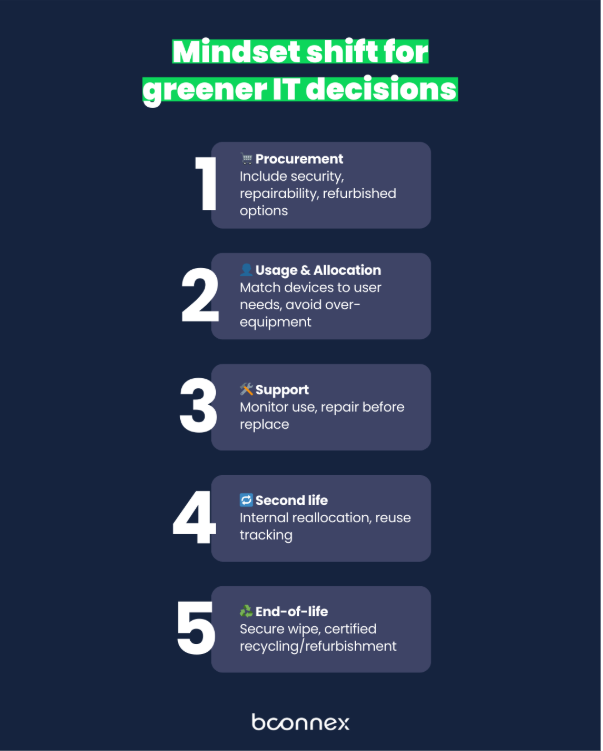
With centralized ITAM platforms like mobilehub, companies can track the environmental performance of their IT fleets across multiple sites and departments. This data-driven approach enables better reporting for Scope 3 emissions and aligns IT decisions with CSR objectives.
In short, with mobilehub, bconnex helps organizations make sustainability measurable, turning every IT decision into a visible, reportable CSR contribution.
Ultimately, responsible ITAM creates a virtuous circle: less waste, more value, and stronger transparency across the company’s sustainability roadmap.
Technology is now part of every employee’s daily routine. A slow or unreliable device, a late replacement, or inconsistent access to the right tools can easily lead to frustration and lost time. On the other hand, smooth, efficient, and ergonomic IT experiences create a sense of comfort and trust, two essential drivers of engagement.
When ITAM is aligned with HR, it goes beyond device management. It becomes a way to support teams, empower individuals, and foster inclusion.
A people-focused ITAM strategy can help:
📊 According to the Riverbed Technology, 95% of business and IT leaders say delivering a seamless digital employee experience is important for remaining competitive.
Source: Riverbed Technology. “Global Digital Employee Experience (DEX) Survey 2023”.
When employees feel equipped, connected, and supported, they are more engaged and loyal. And when IT, HR, and CSR teams collaborate to make this happen, the result is not just operational efficiency, but also a stronger company culture.
For many organizations, ITAM has become the missing link between digital performance and employee well-being. Because beyond processes and dashboards, it’s a daily experience that affects how people feel, focus, and collaborate.
For IT and fleet managers, digital well-being starts behind the scenes, with tools and processes that make their daily work easier, more reliable, and more transparent. When IT teams are equipped with the right platform, they can anticipate issues, act faster, and deliver better service to all employees.
This is where mobilehub, developed by bconnex, comes in.
📊 According to Gartner’s Digital Workplace Trends 2024 report, 82% of companies investing in digital employee experience (DEX) tools see measurable gains in productivity and satisfaction within the first year.
Designed to simplify IT operations, mobilehub centralizes all essential information about users, devices, operators, and systems in one place. It helps IT teams automate repetitive tasks, reduce errors, and gain a real-time overview of the entire IT fleet.
In short, mobilehub achieves this by providng:
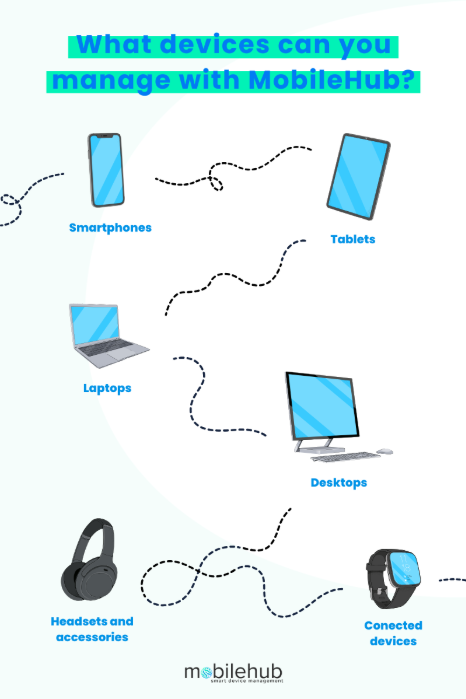
By streamlining these processes, mobilehub helps IT teams reduce workload and increase responsiveness, directly improving the digital experience of every employee. For organizations, this means fewer bottlenecks, faster device availability, and stronger alignment between IT, HR, and CSR priorities, all within a single, data-driven platform.
And by connecting the dots between ITAM, HR, and CSR, companies can transform their digital environments into performance ecosystems where efficiency, well-being, and responsibility reinforce each other every day.
In 2025, ITAM is no longer just about managing devices, it’s about managing the experience behind them, meaning the way people work, collaborate, and contribute to a company’s broader mission.
When IT, HR, and CSR come together, ITAM becomes a unifying philosophy, one that combines operational excellence, employee engagement, and environmental responsibility. And nowadays, a well-managed IT fleet is not only more efficient and secure, it’s also a reflection of how an organization cares for its people and its planet.
At bconnex, this vision drives everything we do, whether through our dedicated ITAM platfrom or through our complementary services:
The future of ITAM lies in collaboration, anticipation, and shared values. And it starts with choosing tools and strategies that put people and purpose at the center of technology.
