



Every year, the world produces 62 million tonnes of electronic waste*, and this amount is constantly rising. Yet in most companies, the reflex remains the same: when equipment gets old, it’s replaced. What if the best decision for your budget and for the planet were simply to make what still works last longer?
*Source: Notre environnement.gouv: “When electronic waste hits record levels”
Businesses have for a long time aligned the renewal of their IT equipment with the cycles of technological innovation. New processors, new connectivity standards, new features: these are all reasons to upgrade a fleet of devices. But this approach comes at an environmental cost that recent data makes hard to ignore.
Contrary to what one might think, it is not the day-to-day use of our devices that accounts for the largest share of the digital sector’s carbon footprint. It is their manufacture, accounting for around 80% of their total carbon footprint, according to a joint study by ADEME and Arcep.* The extraction of raw materials, transport from production sites, and the energy used for assembly – all of this is already ‘used up’ before the device is even used for the first time.
This imbalance has practical implications for businesses: when equipment that is still in working order is replaced, the bulk of its environmental cost, that associated with its manufacture, has already been incurred. Conversely, every additional month of use helps to offset this initial environmental impact.
*Source: ADEME-Arcep, “Study on the environmental footprint of the digital sector in 2020, 2030 and 2050” – 2023
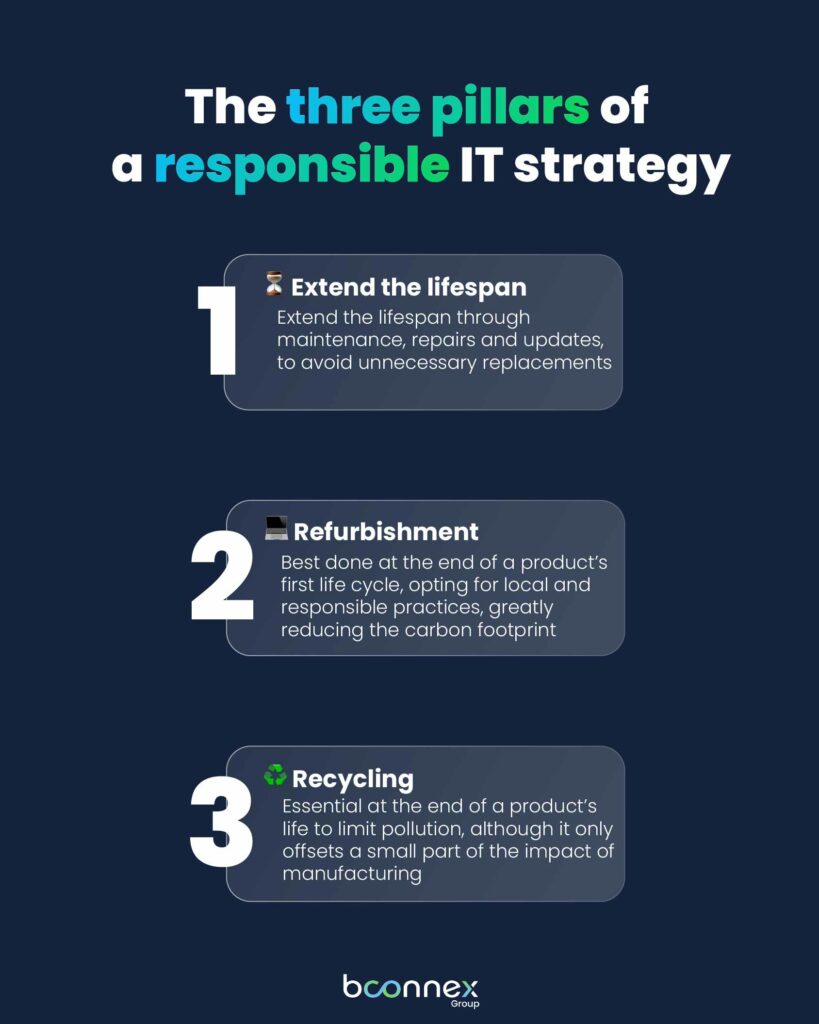
Given this situation, businesses have practical measures they can take, long before recycling becomes necessary. The order of priority is clear: extend the product’s life first, refurbish it next, and recycle only as a last resort.
The first, and by far the most effective, approach is to extend the useful life of existing equipment. A product’s lifespan is a major factor in its overall environmental impact.
In practical terms, this involves taking a few simple steps: routine maintenance, cleaning, replacing worn parts (batteries, damaged components) and updating software. These actions do not require significant resources, but they do require organisation and awareness from IT teams. All too often, equipment is scrapped not because it is beyond repair, but because no one has had the time to assess whether it could be restored to working order.
As well as routine maintenance, extending the lifespan of equipment also requires rigorous day-to-day fleet management. Ensuring that equipment is properly collected when an employee leaves or changes role, checking it, and then reallocating it to another colleague: these are all habits that prevent equipment that is still in working order from ending up in a drawer or in the bin. This is one aspect of the support we offer at bconnex, because the best way to make equipment last is, first and foremost, not to lose track of it.
When equipment reaches the end of its first life cycle, reconditioning offers a middle ground between replacement and disposal. It is with this in mind that bconnex supports you by offering reliable, tested and guaranteed reconditioned equipment, a practical alternative to systematic replacement.
👉 To find out more about this topic, check out our 10 steps to making your IT infrastructure more sustainable.
💡 ADEME has assessed the environmental footprint of five categories of refurbished digital products across their entire life cycle. The results are clear: buying a refurbished product rather than a new one reduces the annual carbon footprint by between 43% and 97%, depending on the type of equipment.*
*Source: ADEME, ‘Assessment of the environmental impact of a range of refurbished products’, September 2022
The study points out, however, that these benefits depend heavily on the refurbisher’s practices. Local refurbishment, carried out within a short supply chain and retaining as many original parts as possible, maximises the environmental benefit. In contrast, refurbishment that involves the systematic replacement of components and intercontinental transport significantly reduces the advantage over buying new.
Recycling is often presented as the default solution to the problem of electronic waste. In reality, it comes at the end of the process and offsets only a fraction of the impact of manufacturing. Globally, less than a quarter of WEEE is properly collected and recycled, and France itself falls short of European collection targets.*
Recycling remains essential for recovering end-of-life materials and reducing pollution. However, it is best used as a last resort: a two-year-old pair of headphones still retains real value, both environmentally and economically, which should be exploited before considering them end-of-life.
*Sources : Global E-Waste Monitor 2024 ; INSEE, 2024
Of all the IT equipment in a company, professional headsets deserve special attention. With the rise of hybrid working and video conferencing, they have become an everyday tool for millions of employees. The number of headsets in IT fleets has increased significantly in recent years, and with it, the challenges of managing them.
In practice, the need to replace a headset is rarely triggered by a permanent fault. The most common reasons are worn or dirty ear pads, a battery that is losing its charge, a Bluetooth pairing issue, or simply a need for hygiene after shared or intensive use. These are all issues that can be addressed through maintenance or repair, not replacement.
In many companies, however, these situations lead to the same outcome: ordering new headsets and disposing of the old ones, simply because there is no time or no straightforward alternative. Beyond the purchase cost, this cycle generates an administrative burden that is often underestimated: managing orders, deliveries, and the collection and regulatory disposal of WEEE.
Headphones are also a common blind spot in responsible digital policies. Efforts generally focus on computers, servers and smartphones – the most visible items on the inventory. But when you’re dealing with a fleet of several hundred units, headphones represent a real opportunity for savings and reducing the environmental footprint, provided that a dedicated management system is put in place.
The fact is that managing the cleaning, sterilisation, diagnosis and repair of headphones on a large scale in-house requires time and specialist equipment. Without a suitable solution, replacement is often the quickest option.
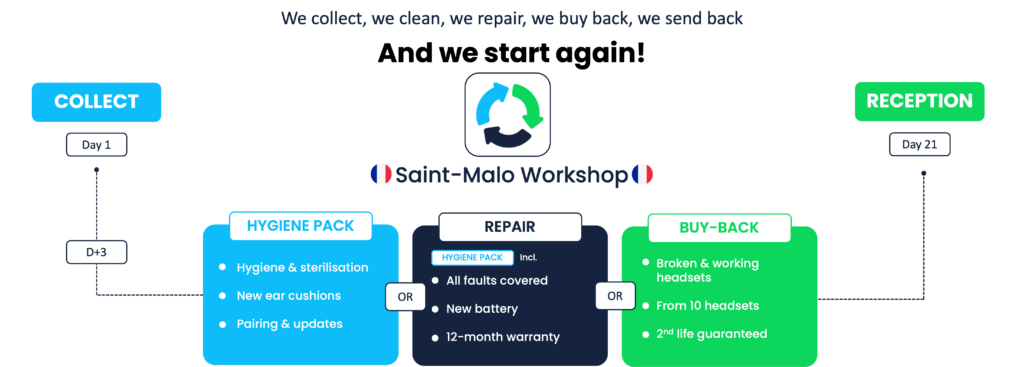
This is the solution we’ve chosen to provide at bconnex, with Casque as a Service. The idea is to enable you to outsource the maintenance, repair and reconditioning of professional helmets as part of a circular economy approach, supported by a dedicated workshop based in Saint-Malo.
For businesses, the process is designed to be as simple as possible: simply send your headsets to the warehouse in Saint-Malo, bconnex covers the shipping costs, and choose the level of service you require.
Headphones with worn ear pads that need a good refresh will undergo a full sterilisation, replacement of the ear pads, pairing and a software update. If the problem is more serious (battery at the end of its life, technical fault), the service covers a full repair using new parts, all backed by a 12-month warranty. And for headphones that have definitely seen better days, bconnex offers a buy-back scheme for orders of 10 units or more, whether they are in working order or not, guaranteeing them a second life and relieving the company of the burden of managing WEEE.
In any case, the principle remains the same: each headphone is processed at the correct level, without any unnecessary adjustment.
👉 Find out about our standards for refurbishment: bconnex aims for excellence even in the refurbished appliances it supplies to its customers
Headphones that have been refurbished in our workshop can certainly be reallocated to new employees within your company. A refurbished headphone offers the same guarantees of hygiene and performance as a brand-new model, at a fraction of the original cost.
And when a headphone is bought back by bconnex or is no longer suitable for return to your fleet, we can also supply you with refurbished headphones from our supply chain to meet your needs. Together, this forms a coherent cycle: collect, clean, repair, buy back, return. Each headphone stays in the loop for as long as possible, benefiting both your business and the environment.
The transition to more sustainable IT does not necessarily require major investment or technological revolutions. It begins with a shift in perspective regarding existing equipment. As manufacturing accounts for the bulk of the digital sector’s environmental impact, every extra month of use represents a real benefit, both economically and environmentally.
When it comes to professional headsets, which are sometimes overlooked in responsible digital strategies, certain approaches demonstrate that it is possible to balance user experience, cost control and environmental responsibility. The key is to view refurbishment not as a compromise, but as a fully-fledged process that is integrated into the equipment’s life cycle.
Contact bconnex group to review your headset fleet and let’s discuss how we can tailor our services to your needs.
